
Introduction
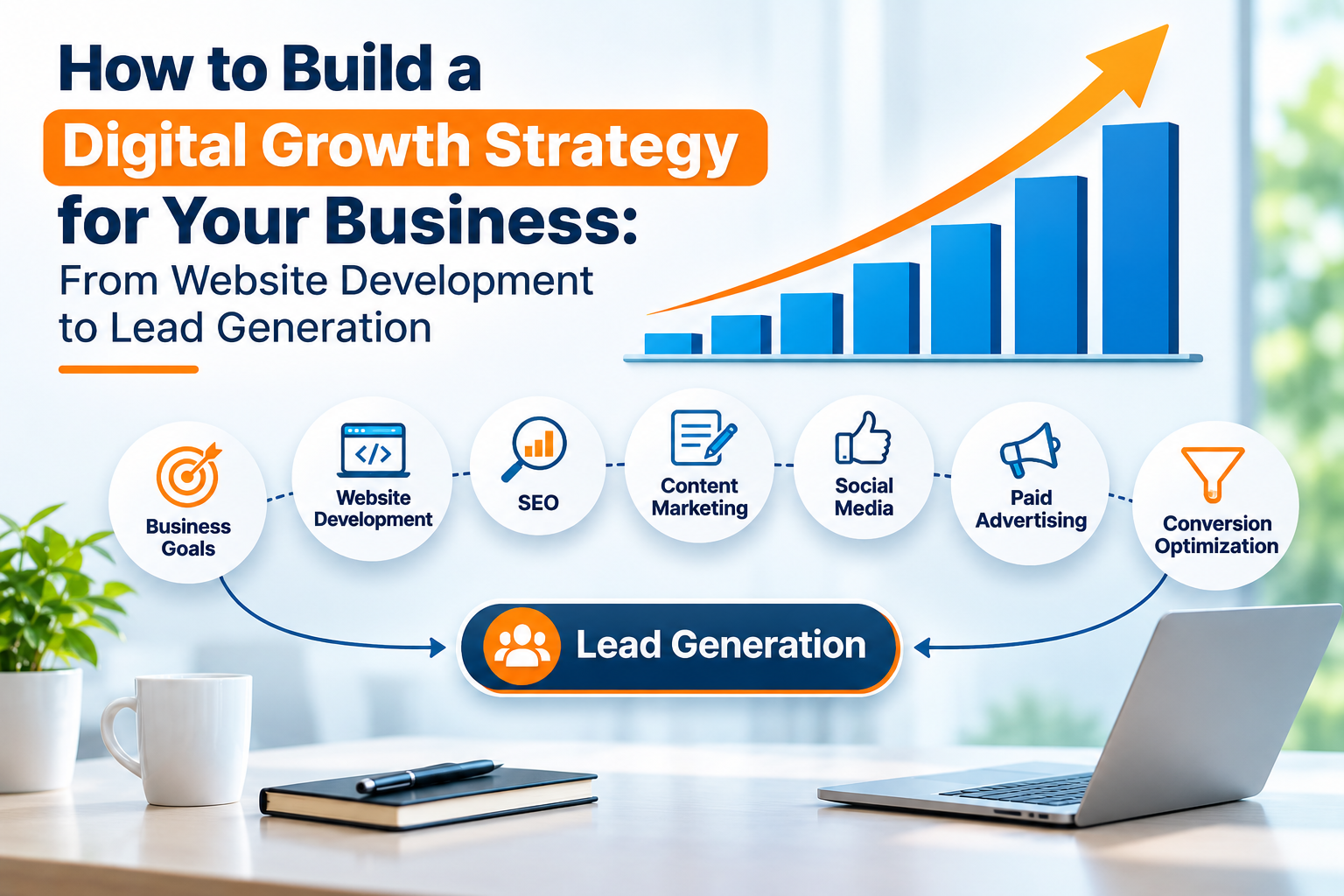
Every growing business needs a clear digital strategy to attract the right audience, generate qualified leads and increase revenue. A strong foundation begins with professional website development and connects it with SEO, content marketing, social media, paid advertising and conversion optimization.
However, sustainable digital growth rarely comes from relying on a single marketing channel. When these activities work together towards clearly defined business objectives, they create a more structured and measurable approach to online growth.
Let’s explore how businesses can build an integrated digital growth strategy, from establishing a strong online presence to converting potential customers into valuable business opportunities.
1. Define Clear Business Goals and Growth Objectives
Before investing in digital marketing, identify what your business wants to achieve. A strategy without clear objectives can lead to disconnected marketing activities and inefficient resource allocation.
Your business goals may include:
- Generating more qualified enquiries.
- Expanding into international markets.
- Increasing e-commerce sales.
- Building stronger brand awareness.
- Improving customer acquisition.
- Increasing customer retention and repeat purchases.
Set measurable targets and realistic timelines for each objective. This will help you select suitable marketing channels and evaluate whether your activities are contributing to business growth.
2. Build a Strong Digital Foundation With Website Development
Your website is the central destination for most of your digital marketing activities. It should communicate your business value clearly and make it easy for visitors to understand your products or services.
A professionally developed website should answer five important questions:
- Who are you?
- What products or services do you offer?
- Who are your target customers?
- Why should customers choose your business?
- How can visitors contact you or make a purchase?
Beyond its appearance, your website should be mobile-friendly, secure, technically optimized and easy to navigate.
Fast loading speed, clear navigation, accessible information and well-placed calls to action can also improve the overall user experience.
A strong website provides the foundation for SEO, paid advertising, social media campaigns and lead-generation activities.
3. Develop an SEO Strategy to Improve Organic Visibility
Search engine optimization helps your business become discoverable when potential customers search for relevant products, services or solutions.
An effective SEO strategy should focus on attracting relevant organic traffic rather than simply increasing website visits.
Key activities include:
- Keyword Research: Identify relevant search terms based on customer intent and business offerings.
- Competitor Analysis: Understand how competing businesses attract organic visibility.
- Technical SEO: Improve website structure, indexing, loading speed and crawlability.
- On-Page Optimization: Optimize service pages, headings, URLs, metadata and internal links.
- Content Development: Publish useful and relevant content that addresses customer requirements.
- Link Building: Build relevant and credible backlinks to strengthen website authority.
- Performance Tracking: Monitor rankings, organic traffic, conversions and engagement.
For businesses targeting international markets, keyword research should also consider regional search behaviour, language preferences and local competition.
4. Use Content Marketing to Build Trust and Authority
Content marketing allows businesses to communicate their expertise, answer customer questions and build stronger relationships with their audience.
Instead of creating content only to include keywords, focus on addressing genuine customer challenges and providing useful information.
Consider developing different content formats, such as:
- Educational blog articles.
- Industry reports and insights.
- Case studies.
- Expert opinions.
- Customer success stories.
- Video explainers.
- Frequently asked questions.
A consistent content strategy can support SEO, improve brand credibility and help potential customers understand your products or services before making a decision.
5. Strengthen Brand Recognition Through Social Media Marketing
Social media helps businesses increase brand visibility, communicate with potential customers and maintain ongoing engagement.
However, effective social media marketing requires more than publishing regular posts. Your content should reflect your brand identity and provide value to the audience.
Build a consistent publishing strategy around:
- Educational and informative content.
- Industry trends and updates.
- Product and service insights.
- Thought leadership.
- Customer experiences and success stories.
- Brand updates and announcements.
Choose platforms according to your target audience and business objectives rather than trying to maintain an active presence everywhere.
6. Accelerate Customer Acquisition Through Performance Marketing
While SEO and content marketing help build long-term visibility, paid advertising can provide additional opportunities to reach relevant audiences and generate enquiries.
Depending on your business model and target market, consider:
- Google Search campaigns.
- Meta advertising.
- LinkedIn advertising where relevant.
- Remarketing campaigns.
- Lead-generation campaigns.
- Conversion-focused landing pages.
However, running advertisements is only one part of performance marketing. Campaigns should be supported by accurate conversion tracking, relevant landing pages and regular performance analysis.
Monitor metrics such as qualified leads, cost per lead, conversion rate and customer acquisition cost to understand whether your advertising investment is delivering meaningful results.
7. Optimize the Customer Journey to Improve Conversions
Attracting website traffic does not automatically translate into leads or sales. Businesses also need to understand how visitors move from discovering a brand to taking action.
Review the customer journey and identify areas where visitors may lose interest or experience difficulty.
You can improve conversion opportunities through:
- Clear and compelling value propositions.
- Relevant landing pages.
- Strong and visible calls to action.
- Customer testimonials and reviews.
- Simple enquiry and contact forms.
- Transparent product and service information.
- Fast and user-friendly website experiences.
Even small improvements to the customer journey can help businesses make better use of their existing website traffic.
8. Measure Digital Marketing Performance With Meaningful KPIs
A digital growth strategy should continuously evolve based on performance data. Tracking the right key performance indicators (KPIs) helps businesses understand which activities are working and where improvements are needed.
Important performance indicators include:
- Organic Traffic: Measures website visits generated through organic search.
- Paid Traffic: Measures visitors attracted through paid advertising campaigns.
- Qualified Leads: Measures enquiries that match business requirements and target audiences.
- Conversion Rate: Measures the percentage of visitors who complete a desired action, such as submitting an enquiry or making a purchase.
- Cost Per Acquisition (CPA): Measures the average cost of acquiring a customer.
- Revenue: Measures income generated through sales and helps connect marketing activities with business outcomes.
Use these insights to evaluate channel performance, identify opportunities and allocate marketing budgets more effectively. Most importantly, connect marketing performance with actual business outcomes instead of focusing only on impressions, clicks or website traffic.
9. Create a Scalable Digital Marketing System
As a business grows, its marketing activities become more complex. Managing different channels without defined processes can create inconsistencies and make performance difficult to evaluate.
A scalable marketing system should include:
- Clearly defined marketing responsibilities.
- Structured content calendars.
- Organized campaign workflows.
- Accurate conversion tracking.
- Consistent reporting schedules.
- Regular performance reviews.
- Clear communication processes.
These systems help businesses maintain consistency, improve coordination and make informed decisions as their marketing requirements expand.
Conclusion
Building a digital growth strategy is not simply about increasing website traffic, publishing more social media content or running additional advertising campaigns.
It is about creating a connected digital ecosystem that attracts the right audience, communicates business value, generates qualified enquiries and supports long-term business objectives.
By combining professional website development, SEO, content marketing, social media, performance advertising and conversion optimization, businesses can establish a stronger digital foundation.
CrazyChiefs helps businesses connect these digital marketing activities through integrated strategies focused on online visibility, customer acquisition and measurable growth opportunities.
Whether your objective is to strengthen your online presence, expand into new markets or generate more qualified leads, a well-planned digital strategy can help create a clearer path towards sustainable growth.
If you are planning to improve your online presence, explore how website development can become an important part of your digital growth strategy.
Frequently Asked Questions
Q1. What is a digital growth strategy?
A digital growth strategy is a structured plan that uses online channels, technology and marketing activities to attract customers, improve visibility and support business growth.
Q2. What are the main components of a digital growth strategy?
The main components include website development, SEO, content marketing, social media marketing, performance advertising, lead generation and conversion optimization.
Q3. How can a business generate more online leads?
Businesses can generate more online leads through targeted SEO, valuable content, paid advertising, optimized landing pages and clear enquiry pathways.
Q4. Is digital marketing important for business growth?
Digital marketing can help businesses improve online visibility, reach relevant audiences, build customer relationships and generate sales opportunities.
Q5. How can businesses measure digital growth?
Businesses can measure digital growth by tracking organic visibility, qualified leads, conversion rates, customer acquisition costs and marketing-attributed revenue.

Comments are closed