
Introduction
When businesses want to grow online, one common question comes to mind: should they invest in SEO or paid advertising? Both strategies help businesses increase online visibility, attract potential customers, and generate leads. However, they work differently and deliver results over different timeframes. Businesses can also explore professional Paid Advertising Services to reach their target audience and improve campaign performance.
Understanding SEO and paid advertising is important for businesses that want to make better marketing decisions and achieve a higher return on investment (ROI). While SEO focuses on improving organic search visibility, paid advertising helps businesses reach their target audience through sponsored campaigns.
Choosing the right strategy depends on your business goals, budget, competition, and how quickly you want to see results. Let’s understand both approaches and explore which one can deliver better ROI for your business.
1. What Is Search Engine Optimization (SEO)?
Search Engine Optimization (SEO) is the process of improving a website’s visibility in organic search engine results. It involves optimizing website content, technical performance, keywords, and backlinks to help search engines understand and rank web pages.
The main objective of SEO is to attract relevant visitors without paying for every click.
Some important SEO activities include:
- Keyword Research: Identifying the search terms potential customers use to find products or services.
- On-Page SEO: Optimizing page titles, meta descriptions, headings, content, and internal links.
- Technical SEO: Improving website speed, mobile-friendliness, indexing, and overall website performance.
- Off-Page SEO: Building quality backlinks and improving website authority.
- Content Optimization: Publishing useful and relevant content that addresses users’ search queries.
For example, if someone searches for a digital marketing agency in Delhi, a business with a well-optimized website may appear in the organic search results.
SEO generally takes time to show meaningful results, but it can help businesses build long-term online visibility and attract consistent organic traffic.
2. What Is Paid Advertising?
Paid advertising is a digital marketing strategy in which businesses pay platforms to display their advertisements to a specific audience. These ads can appear on search engines, social media platforms, and other websites.
Unlike SEO, paid advertising can generate visibility and website traffic as soon as campaigns become active.
Some common paid advertising platforms include:
- Google Ads: Helps businesses display advertisements on Google search results and its advertising network.
- Meta Ads: Allows businesses to reach audiences through Facebook and Instagram.
- LinkedIn Ads: Helps businesses target professionals and decision-makers based on their industry, job title, and other professional details.
Performance marketing focuses on measurable campaign outcomes such as leads, purchases, enquiries, and conversions.
If you want to understand how performance marketing uses measurable results, audience targeting, and campaign optimization to improve ROI, read our article on The Power of Performance Marketing: Unleashing Business Growth.
Paid advertising can be useful for businesses that want faster visibility, promote specific offers, or generate leads within a defined period. However, businesses need to manage their budgets carefully because traffic generally stops when advertising campaigns are paused.
3. SEO vs Paid Advertising: Key Differences
Both SEO and paid advertising help businesses attract online audiences, but their approach, cost structure, and results are different.
1. Traffic Type
- SEO: Generates organic traffic through search engine results.
- Paid Advertising: Generates paid traffic through sponsored advertisements.
2. Cost
- SEO: Requires investment in website optimization, quality content, and ongoing SEO activities.
- Paid Advertising: Requires an advertising budget to display ads and attract visitors.
3. Results
- SEO: Usually takes time to improve rankings and generate consistent organic traffic.
- Paid Advertising: Can generate website traffic quickly once campaigns become active.
4. Visibility
- SEO: Helps websites appear in organic search engine rankings.
- Paid Advertising: Displays sponsored advertisements on search engines and other advertising platforms.
5. Long-Term Value
- SEO: Can generate ongoing organic traffic and provide long-term visibility.
- Paid Advertising: Depends on continued advertising spend to maintain visibility and traffic.
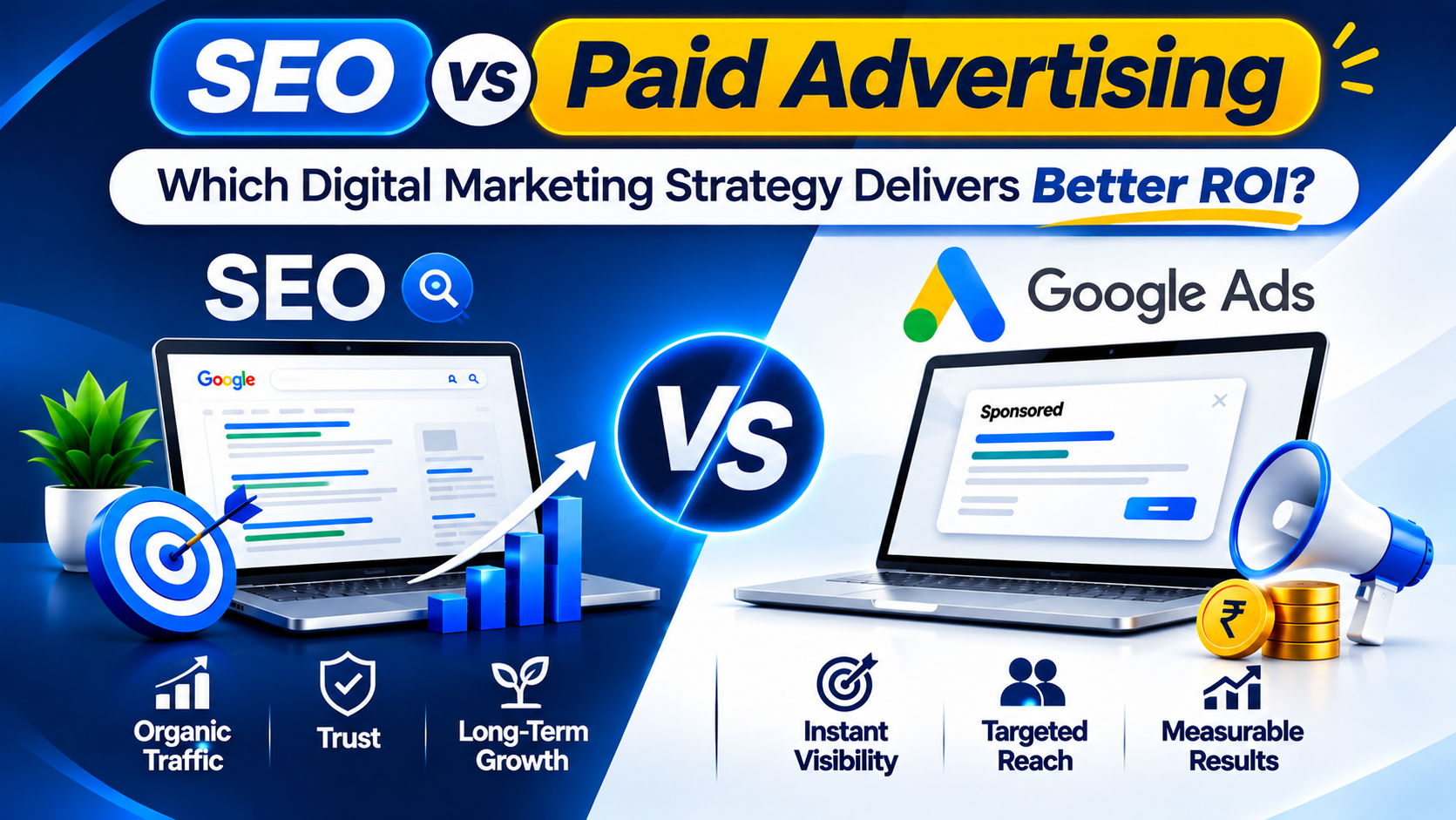
The main difference in SEO and paid advertising is that SEO builds organic visibility over time, while paid advertising provides immediate exposure through sponsored placements.
Both approaches can support business growth, but the right choice depends on the company’s objectives and available resources.
4. Which Strategy Delivers Better ROI?
Return on Investment (ROI) is one of the most important factors businesses consider when choosing a digital marketing strategy.
However, SEO and paid advertising deliver ROI differently.
SEO ROI
SEO can provide long-term value because optimized pages may continue attracting organic traffic even after the initial optimization work is completed.
Its potential benefits include:
- Consistent organic website traffic.
- Better visibility in search engine results.
- Increased brand awareness.
- Opportunities to attract users actively searching for relevant services.
- Reduced dependency on paid advertising over time.
However, SEO requires continuous content optimization, technical improvements, and link-building efforts. Results also depend on competition, keyword difficulty, and website quality.
Paid Advertising ROI
Paid advertising can help businesses reach their target audience quickly and generate measurable results through campaigns.
Its potential benefits include:
- Faster website traffic and visibility.
- Control over advertising budgets.
- Audience targeting based on business requirements.
- Measurable clicks, leads, and conversions.
- Flexibility to test different ads and campaign strategies.
However, paid advertising requires continuous spending. If campaigns are not optimized properly, businesses may spend money without generating enough qualified leads or sales.
Therefore, neither strategy guarantees better ROI in every situation. Businesses need to evaluate their goals, customer acquisition costs, conversion rates, and long-term marketing requirements before making a decision.
5. Why Combining SEO and Paid Advertising Can Be More Effective
Instead of choosing only one strategy, businesses can combine SEO and paid advertising to create a more balanced digital marketing approach.
Both strategies can support each other in several ways:
- Faster Visibility: Paid campaigns can generate immediate visibility while SEO efforts gradually improve organic rankings.
- Better Keyword Insights: Paid advertising data can help identify keywords that attract relevant visitors and generate conversions.
- Wider Audience Reach: SEO attracts users through organic search, while paid campaigns can reach additional audience segments.
- Improved Brand Awareness: Appearing in both organic and paid search results can increase brand exposure.
- Balanced Marketing Strategy: Businesses can use paid advertising for short-term goals and SEO for long-term growth.
Combining both approaches can help businesses maintain visibility across different stages of the customer journey.
6. How Businesses Should Allocate Their Marketing Budget
The right marketing budget allocation depends on the business model, industry competition, available resources, and growth objectives.
Here are some general considerations:
For Startups
Startups may use paid advertising to generate initial visibility and test audience interest while building their SEO foundation.
For Small Businesses
Small businesses can focus on local SEO and targeted paid campaigns to attract relevant customers within their service areas.
For Established Businesses
Established businesses can invest in SEO to strengthen organic visibility while using paid advertising for specific products, services, and promotional campaigns.
For E-commerce Businesses
E-commerce businesses can combine SEO product optimization with paid campaigns to attract shoppers and promote specific products.
There is no fixed budget allocation that works for every business. Regular performance analysis helps identify which channels are generating better results and where the budget should be adjusted.
Conclusion
Choosing between SEO and paid advertising depends on what your business wants to achieve. SEO is a long-term strategy that helps build organic visibility, website authority, and consistent traffic. Paid advertising, on the other hand, helps businesses reach their target audience quickly and generate measurable campaign results.
When comparing SEO and paid advertising, businesses should not focus only on how quickly traffic arrives. They should also consider lead quality, conversion rates, customer acquisition costs, and long-term business value.
For many businesses, combining SEO and paid advertising can be a practical approach to achieving both short-term visibility and sustainable online growth.
Businesses looking to improve their online visibility and generate measurable results can also explore professional Paid Advertising Services to support their digital marketing goals.
Frequently Asked Questions (FAQs)
1. Which is better, SEO or paid advertising?
Both strategies have different advantages. SEO is useful for long-term organic growth, while paid advertising helps generate faster visibility and traffic. The better option depends on your business goals and budget.
2. Does SEO provide better ROI than paid advertising?
SEO can provide long-term ROI by generating organic traffic over time. However, paid advertising may deliver faster results when campaigns are properly targeted and optimized. Actual ROI depends on business performance and marketing costs.
3. How long does SEO take to show results?
SEO generally takes several months to show noticeable improvements. The timeline depends on website condition, keyword competition, content quality, and optimization efforts.
4. Can small businesses use both SEO and paid advertising?
Yes. Small businesses can combine SEO and paid advertising to build long-term visibility while generating immediate traffic through targeted campaigns. Their budget should be allocated according to business priorities.
5. Should businesses stop paid advertising after ranking on Google?
Not necessarily. Organic rankings and paid campaigns serve different purposes. Businesses can continue using paid advertising for competitive keywords, promotions, and specific campaigns while maintaining their SEO efforts.

Comments are closed