
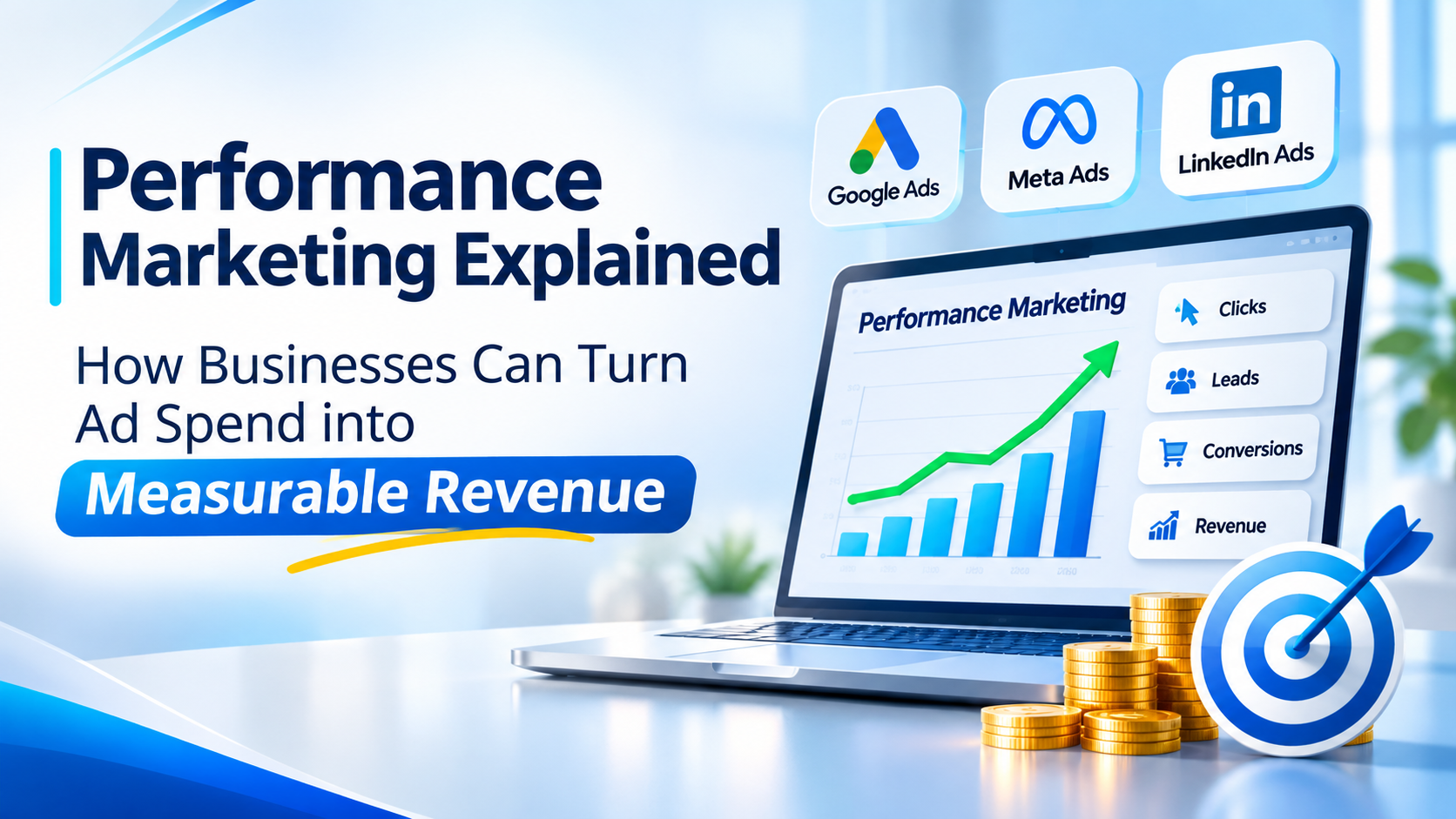
Introduction
Businesses invest in digital advertising to attract potential customers, generate leads and increase sales.
However, spending money on advertisements does not automatically guarantee business growth.
The real objective should be to convert advertising investment into measurable business outcomes.
This is where performance marketing becomes important.
Performance marketing focuses on measurable campaign objectives, data-driven decisions and continuous optimization to improve advertising effectiveness.
1. What Is Performance Marketing?
Performance marketing is a digital advertising approach in which campaigns are planned and optimized around measurable outcomes.
These outcomes may include:
- Website visits.
- Form submissions.
- Qualified leads.
- Online purchases.
- App installations.
- Bookings.
- Revenue generation.
Rather than focusing exclusively on impressions or engagement, performance marketers evaluate how advertising contributes to business objectives.
2. Major Performance Marketing Channels
Google Ads
Google Ads allows businesses to reach users searching for relevant products and services.
Campaign formats include search, display, shopping, video and other available advertising placements.
Meta Ads
Facebook and Instagram advertising help businesses reach relevant audiences through visual and interactive campaigns.
Common objectives include brand awareness, traffic, leads and sales.
LinkedIn Ads
LinkedIn advertising can help B2B businesses reach professional audiences, specific industries and decision-makers.
Remarketing
Remarketing allows businesses to reconnect with eligible audiences who previously interacted with their website or advertising.
3. The Importance of Campaign Strategy
Successful performance marketing begins before launching an advertisement.
The process should include:
- Understanding business objectives.
- Defining target audiences.
- Researching competitors.
- Developing campaign messaging.
- Selecting advertising channels.
- Building landing pages.
- Configuring conversion tracking.
- Establishing campaign budgets.
If you want to understand what to look for when selecting a performance marketing partner, read our article on The Performance Marketing Agency in India: Pay for Results, Not Promises.
4. Landing Pages and Conversion Optimization
A well-designed advertisement may attract visitors, but the landing page determines what happens next.
An effective landing page should have:
- A clear headline.
- A relevant value proposition.
- Strong calls to action.
- Mobile-friendly design.
- Relevant proof points.
- Simple enquiry forms.
- Fast loading performance.
The advertisement and landing page should communicate a consistent message.
5. Important Performance Marketing KPIs
Businesses should monitor key performance indicators (KPIs) to understand campaign effectiveness.
Important Performance Marketing Metrics:
- CPM (Cost per Thousand Impressions): Cost per thousand impressions.
- CPC (Cost per Click): Cost per click.
- CTR (Click-through Rate): Click-through rate.
- CPL (Cost per Lead): Cost per lead.
- CPA (Cost per Acquisition): Cost per acquisition.
- CVR (Conversion Rate): Conversion rate.
- ROAS (Return on Advertising Spend): Return on advertising spend.
Businesses should also measure lead quality, customer acquisition cost and actual revenue.
A low cost per lead is not necessarily a positive result if those leads do not convert into customers.
6. How to Improve Advertising Performance
Performance marketing requires continuous optimization.
Important activities include:
- Testing multiple creative variations.
- Refining audience targeting.
- Reviewing search terms.
- Improving landing pages.
- Monitoring conversion tracking.
- Adjusting budgets.
- Identifying poor-performing campaigns.
- Evaluating lead quality.
Decisions should be based on reliable data rather than assumptions.
7. How to Calculate ROAS
Return on Advertising Spend is calculated as:
ROAS = Revenue Attributed to Advertising ÷ Advertising Spend
For example:
If a business spends $2,000 on advertising and generates $8,000 in attributed revenue:
ROAS = $8,000 ÷ $2,000 = 4x
This represents $4 in attributed revenue for every $1 spent on advertising.
However, ROAS is not the same as profit or overall marketing ROI because it does not automatically account for product costs, operating expenses and agency fees.
Conclusion
Performance marketing helps businesses make more informed advertising decisions through measurable objectives, campaign analysis and continuous improvement.
The combination of strategic planning, effective creatives, accurate tracking and conversion optimization can help businesses improve their customer acquisition efforts.
CrazyChiefs offers performance marketing solutions focused on Google Ads, Meta Ads, campaign optimization and measurable business growth.
Frequently Asked Questions
Q1. What is a performance marketing agency?
A performance marketing agency plans, manages and optimizes paid digital campaigns around measurable business outcomes.
Q2. Is performance marketing suitable for small businesses?
Yes. Campaigns can be planned according to business objectives, target audiences and available budgets.
Q3. What is the difference between digital marketing and performance marketing?
Digital marketing includes multiple online marketing activities, while performance marketing specifically emphasizes measurable campaign outcomes.
Q4. How do you measure performance marketing success?
Common metrics include CPL, CPA, conversion rate, ROAS, customer acquisition cost and revenue.
Q5. Which platform is best for performance marketing?
Google Ads, Meta Ads and LinkedIn Ads serve different purposes. Platform selection depends on the target audience and buying journey.

Comments are closed